Bougie Huevos Rancheros
1
2 minutes
12 minutes
This dish creates an unexpected yet harmonious dialogue between the rustic warmth of the Mexican countryside and the refined discipline of a Parisian bistro. By removing the traditional tortilla, the focus shifts entirely to the interplay of textures: the velvety egg, the hearty starch of the beans, and the cooling tang of crème fraîche.
A Tale of Two Histories
Classic Huevos Rancheros ("ranch-style eggs") originated on rural Mexican farms.
In stark contrast, the French Omelette is a product of 19th-century French culinary codified technique. Unlike the fluffy, browned American diner omelette, the classic French version is pale, smooth, and rolled into a cigar shape.
The Creative Blend
This recipe bridges these two worlds by replacing the crispy fried egg with the delicate French fold. The robust Mayan Red Rub—with its deep notes of achiote and cumin—provides the "ranchero" soul, while the omelette offers a luxurious, custard-like mouthfeel. The crème fraîche serves as the bridge, nodding to Mexican crema while adhering to French dairy traditions.
The Challenge
The Test of a Chef
While the seasoned beans come together effortlessly, the true challenge of this recipe lies in the French Omelette. For over a century, chefs have been tested on their ability to make one, and it remains notoriously difficult to master.
Why is it so hard? It requires perfect heat management.
No Browning: Unlike a fried egg, a French omelette should have zero color.
The Texture: The goal is an interior that is baveuse (slightly runny or creamy). You have a window of only about 30 seconds where the egg is set enough to roll but soft enough to remain creamy inside. It requires rapid agitation of the pan and the fork simultaneously—a motion that feels unnatural until practiced.
Directions
Heat the olive oil in a small skillet over medium heat.
Reduce the Beans
Pour the undrained black beans and the seasoning rub directly into a small skillet or saucepan.
Bring to a boil over medium-high heat.
Reduce heat to medium-low and simmer vigorously for 5–8 minutes.
- Stir occasionally. The beans are ready when the liquid has reduced by half and formed a thick, gravy-like consistency. Remove from heat.
Make the French Omelette
NOTE: Fully cook the black beans before cooking the omelette because you will roll the omelette from the pan on top of the beans.
Whisk the eggs with a pinch of salt and pepper until completely uniform in color.
Heat a non-stick pan over medium-low heat and melt the butter.
- Pour in the eggs. Shake the pan back and forth while stirring rapidly with a fork or spatula to form small, soft curds.
- Once the eggs are set but still look glossy and moist on top, stop stirring.
- Tilt the pan and roll the omelette down into a soft cylinder or fold it in half.
Assemble
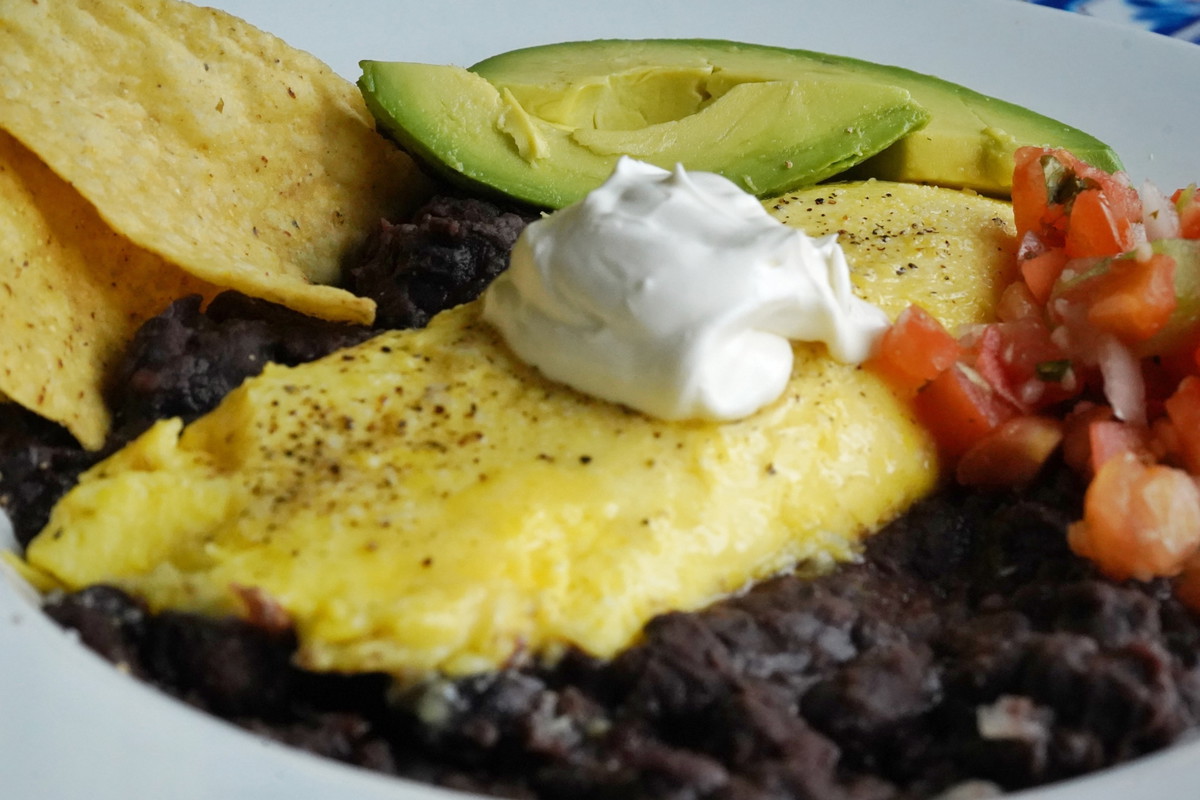
Spoon the seasoned beans directly into the center of a shallow bowl or plate.
Slide the French omelette gently on top of the beans.
Place a dollop of crème fraîche on the center of the omelette.
Serve
Arrange the tortilla chips and the picante sauce on the side. The chips can now be used to scoop up the bean and egg mixture directly.